Dragonfly Spiritual Meaning: What It Can Stand For
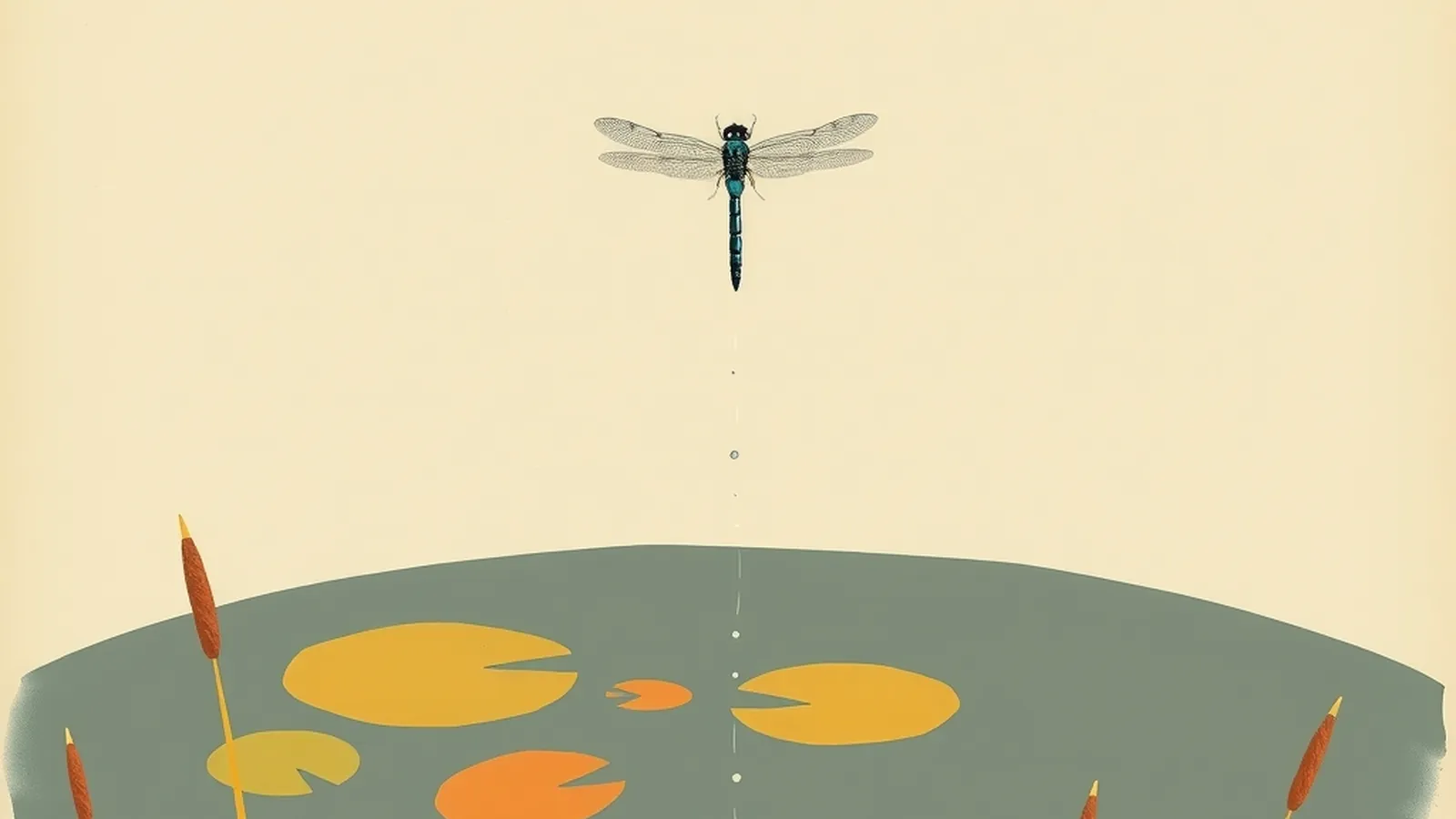
The dragonfly is most often read as a symbol of change, adaptability and seeing past surface appearances. In Japan, where it's called tombo, it has long stood for strength and victory. These meanings are beliefs and traditions, not predictions, but a dragonfly can be a useful prompt to ask where you're growing and what you're ready to leave behind.
This page is part of our guide to spiritual meanings of signs and symbols, which treats each sign as an invitation to reflect rather than a message with a fixed answer.
What people believe a dragonfly means
Most of what you'll read about dragonfly symbolism online is modern, and it tends to circle a few themes:
- Transformation. Because dragonflies start life underwater and later take to the air, many people see them as a picture of a life stage ending and another beginning.
- Lightness. Their quick, hovering flight is often linked with letting go of heaviness, whether that's an old grudge, a rigid plan or a habit of overthinking.
- Seeing clearly. Dragonflies have very large eyes, so modern writers often connect them with perception and looking beyond illusions.
- Living in the present. The adult stage is short compared with the time spent underwater, which some people take as a reminder to enjoy the season you're in.
None of these are rules. If a dragonfly shows up during a hard week and you feel calmer watching it, that's a meaning worth keeping, even if it isn't on any list.
The dragonfly in Japan
The clearest historical example of dragonfly symbolism comes from Japan. There, the dragonfly has long been associated with strength, courage and victory, partly because it flies forward with such purpose. You'll find dragonfly motifs in traditional art, textiles and decorative objects.
If you're drawn to this meaning, it's worth treating it as part of a living culture rather than a borrowed charm. Reading about Japanese art and history, or visiting a museum collection, gives the symbol its proper context.
Indigenous and other traditions
You'll often see websites claim to speak for "Native American" dragonfly beliefs. That framing doesn't hold up. There are hundreds of distinct Indigenous nations in North America alone, each with its own languages, stories and protocols, and beliefs about animals vary between them. Some teachings are not meant to be shared outside the community at all. If you want to learn what the dragonfly means to a particular nation, the respectful route is to learn from that community directly, through its own cultural centers, publications or educators.
The natural side: what dragonflies really are
Knowing a little biology can make the symbolism richer, not weaker.
- An ancient lineage. Relatives of today's dragonflies date back more than 300 million years, long before dinosaurs. Some of those early relatives were far larger than any insect alive now.
- A water-based childhood. Dragonfly eggs hatch into nymphs that live in ponds, lakes and streams. In some species the nymph stage lasts for years. When it's ready, the nymph climbs out of the water, splits its skin and emerges as a winged adult.
- Skilled hunters. Adult dragonflies catch other insects in mid-air, including mosquitoes. Their two pairs of wings can move independently, which helps them hover, turn sharply and even fly backward.
- Huge eyes. Their compound eyes cover much of the head and give them a very wide field of view.
A dragonfly near you usually means there's fresh water nearby and a decent supply of small insects. That's a quiet sign of a working ecosystem, which is meaningful in its own way.
How the dragonfly connects to other signs
The dragonfly sits in a small family of "change" symbols. The butterfly is its closest cousin, since both go through a dramatic shift between life stages, though the butterfly's metamorphosis includes a chrysalis and the dragonfly's doesn't. The owl offers a contrast worth comparing: where the dragonfly is about quick, light movement in daylight, the owl is linked with patience and seeing in the dark. And the rainbow shares the dragonfly's play of light, since sunlight on dragonfly wings can shimmer in a similar way.
A short reflection practice: the surface and the depths
This takes about ten minutes. You can do it after seeing a dragonfly or any time the theme of change feels close.
- Picture the pond. Sit comfortably and imagine still water. Below the surface is the long, hidden part of a dragonfly's life. Above it is the brief, visible part.
- Name your "underwater" season. Think of something in your life that's been developing slowly and out of sight: a skill, a decision, a healing process, a relationship.
- Notice what's ready to surface. Ask yourself what small, visible step would show that this growth is real. Keep it concrete, like sending one email or booking one class.
- Let something lighten. Take three slow breaths. On each exhale, picture setting down one thing you've been carrying that the next stage doesn't need.
- Write one sentence. Finish with a single line about the step you'll take this week.
Symbols work best when they lead to action. If the dragonfly points you toward a bigger question about direction, our guide to finding your life purpose breaks that question into smaller, practical pieces. For more prompts like the ones below, see our manifestation journal prompts.
Journal prompts
- What part of my life has been growing "underwater," where others can't see it yet?
- If I moved through this week with a little more lightness, what would I stop doing?
- Where am I seeing only the surface of a situation, and what might be underneath?
- What would a small "victory," in the Japanese sense of steady courage, look like for me right now?
A grounded way to hold this meaning
There's no evidence that a dragonfly appearing carries a message meant for you. What it can do is pause your day long enough to ask a good question. That's true whether you see symbolism as spiritual, psychological or simply poetic. Take the meaning that helps, and pair it with one real step.
For more ways to build a reflective practice, browse the wider spiritual growth section.
Want a structured program to go deeper?
Reading is a start. Some people do better with a guided course they can follow day by day. This button opens a manifestation or meditation program from one of our advertising partners.
See the partner program →We may be paid when you click. The program shown can change. Read its terms before you buy anything. How this works
Frequently asked questions
What does it mean when a dragonfly lands on you?
In modern spiritual belief, a dragonfly landing on you is often read as a nudge to slow down and notice a change you're going through. Biologically, dragonflies often perch on warm, still surfaces between short flights, so it's also simply a lucky close look.
Is a dragonfly a good sign?
In most of the traditions people cite today, yes. In Japan the dragonfly has long stood for strength and victory, and modern symbolism links it with growth and adaptability. It's a meaning you choose to reflect on, not a prediction.
What does a dragonfly symbolize in Japan?
In Japan, the dragonfly (tombo) has long been a symbol of strength, courage and victory, and it appears often in art and design. It's a respected cultural emblem rather than a general good-luck charm.