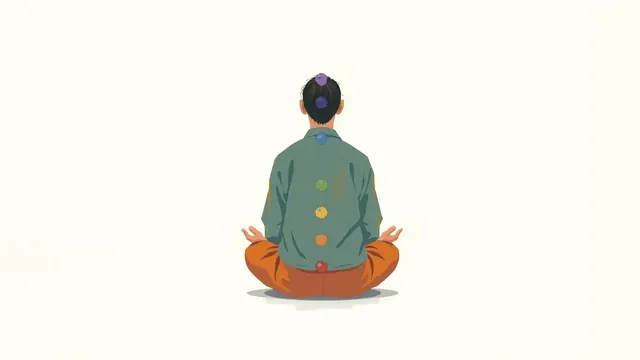
The Throat Chakra (Vishuddha): Speaking and Listening Honestly

The throat chakra, called Vishuddha in Sanskrit, is the fifth of the seven chakras. In yogic and tantric belief it sits at the throat and governs communication: saying what you mean, listening well and expressing yourself creatively. In the modern system its color is blue, its element is space (or ether) and its seed mantra is HAM.
Like every chakra, Vishuddha is part of a spiritual framework, not a body part. There is no scientific evidence that it exists as a physical structure. If you are new to the system, start with our overview of the seven chakras, then come back here for the details.
What does Vishuddha mean?
Vishuddha is usually translated as "especially pure" or "purification." In some tantric readings, this center is where experience is refined and clarified before it rises toward the higher chakras. Western teachers have turned that idea into a practical question: is what you say a clean match for what you think and feel?
Throat chakra at a glance
| Feature | Traditional or common association |
|---|---|
| Location | Throat and neck area |
| Color (modern) | Blue, often sky blue or turquoise |
| Element | Space, also called ether or akasha |
| Seed mantra | HAM |
| Lotus petals | 16 in many traditional descriptions |
| Core themes | Honesty, expression, listening, boundaries |
Details differ between texts. Traditional sources describe this lotus with colors and imagery quite unlike the bright blue used today, and lineages don't always agree with each other. Treat the table as the common modern version, not a fixed rulebook.
Some modern teachers link the throat chakra with the thyroid gland. That connection is a recent interpretation, not medical fact. Nothing about this chakra can tell you anything about your thyroid, voice or throat health.
The themes of the throat chakra
Communication has two halves, and the throat chakra is said to hold both. Speaking is the obvious one. Listening is the quieter one, and practitioners often say it matters just as much.
Common throat chakra themes include:
- Honest speech. Saying what is true for you, kindly and clearly.
- Listening. Hearing others without planning your reply while they talk.
- Boundaries. Being able to say "no" or "not right now" without a long apology.
- Creative voice. Singing, writing, speaking up in a meeting, or any way you put your inner world into words or sound.
- Integrity. Keeping your words and your actions in line.
The throat sits between the heart and the head in the chakra map. Many teachers describe it as the place where feeling and thought find a voice.
Balanced, blocked and overactive: what practitioners describe
These descriptions are emotional and behavioral patterns that practitioners use as a reflection tool. They are not symptoms and they are not a diagnosis.
| State | What practitioners describe |
|---|---|
| Balanced | You say what you mean, listen with patience, ask for what you need and can tolerate a little disagreement. |
| Blocked or underactive | Swallowing your opinions, agreeing to things you don't want, rehearsing conversations you never have, fear of being judged for speaking. |
| Overactive | Talking over people, oversharing, gossip, needing the last word, using bluntness as an excuse for unkindness. |
Most people move between these depending on the setting. You might speak freely with friends and go quiet with your boss. Noticing where your voice changes is often more useful than labeling yourself.
If a sore throat, hoarse voice, lump or swallowing problem shows up, see a doctor. If fear of speaking or social anxiety feels heavy, a licensed therapist can help in ways a chakra practice can't.
Practices for the throat chakra
The throat is the one chakra you can literally hear. That makes sound and breath natural tools. The general approach to chakra balancing covers breath, movement and reflection across all seven centers; here are options that suit Vishuddha in particular.
Chant HAM
Sit comfortably. Breathe in through your nose, then on the exhale chant "hahm" slowly, letting the sound fade into silence. Repeat for three to five minutes. If chanting aloud feels awkward, start by whispering it. This is a form of mantra meditation, and that guide explains how to build a steady sound-based practice.
Humming breath
Known in yoga as bhramari, or bee breath. Close your lips, breathe in, and hum gently on the out-breath. Feel the vibration in your face and throat. Many people find it calming. Keep it soft and stop if you feel lightheaded.
Gentle neck and shoulder movement
Slow neck rolls (half circles, front only), shoulder shrugs and the yoga poses fish and cat-cow are common throat chakra choices. Move within a comfortable range. Skip anything that strains your neck, and ask a doctor first if you have a neck injury.
The unsent letter
Write a letter to someone, saying everything you held back. Don't send it. The point is to hear your own voice on paper before deciding what, if anything, to say out loud.
One honest sentence a day
Pick one small moment each day to say what you actually think. "I'd prefer the earlier time." "I don't agree, and here's why." Practitioners believe energy work matters most when it shows up in real conversations, and this is where it does.
Affirmations
Short spoken statements suit this chakra well, since the practice itself uses the voice. Try "My voice matters," "I can say no kindly" or "I listen to understand." For a full set of seven per chakra, see our chakra affirmations guide.
A short throat chakra journal
Set a timer for ten minutes and pick two or three prompts:
- What did I want to say this week but didn't? What stopped me?
- When do I talk to fill silence instead of to share something?
- Who do I find it easiest to be honest with, and why?
- What is one boundary I'd like to say out loud this month?
- When did someone really listen to me? What did they do?
Read your answers back. Look for one small, specific conversation you could try, then plan when you'll have it.
How the throat chakra connects to its neighbors
The throat rarely works alone in the chakra map. Directly below it is the heart chakra, and practitioners often pair them because honest words land better when they come with compassion. Directly above is the third eye chakra, linked with intuition and insight, which many teachers see as what you are trying to put into words in the first place.
The grounded takeaway
You don't need to believe in subtle energy to get something from throat chakra work. At its simplest, it is a reminder to check whether your words match your inner life, and a set of gentle practices built around breath, sound and honest conversation. The chakra is the symbol. The practice is speaking a little more truthfully and listening a little more closely, one conversation at a time.
Want a structured program to go deeper?
Reading is a start. Some people do better with a guided course they can follow day by day. This button opens a manifestation or meditation program from one of our advertising partners.
See the partner program →We may be paid when you click. The program shown can change. Read its terms before you buy anything. How this works
Frequently asked questions
What does a blocked throat chakra feel like?
Practitioners use "blocked" as a metaphor for patterns like holding back what you mean, people-pleasing or struggling to say no. Any physical throat, voice or thyroid symptom is a reason to see a doctor, not a chakra issue.
What is the mantra for the throat chakra?
The traditional seed syllable, or bija mantra, for Vishuddha is HAM, often pronounced "hahm." Many people chant it slowly on the exhale as part of a short meditation.
What color is the throat chakra?
In the modern Western system the throat chakra is blue, often a clear sky blue or turquoise. Traditional Indian texts describe it differently, so the blue is a recent convention rather than an ancient rule.