Obsidian Meaning: The Volcanic Glass Explained Honestly
Obsidian is natural volcanic glass that forms when lava cools too fast for crystals to grow. In modern crystal belief it's associated with grounding, protection and honest self-reflection, and it's often described as a "mirror" for looking at what you'd rather avoid. There's no scientific evidence that obsidian has energetic or healing effects, but many people find it a striking focus object for reflective practice.
Explore other stones in our crystal meanings guide. If you're brand new to stones, start with crystals for beginners for the basics of choosing and using them.
What obsidian actually is
Obsidian isn't a true crystal. It's a glass, which means its atoms are arranged randomly rather than in the repeating pattern that defines a crystal. It forms when silica-rich lava cools so quickly that crystals never get a chance to organize. On the Mohs hardness scale it rates about 5 to 5.5, softer than quartz.
The most important physical fact about obsidian is how it breaks. Like window glass, it fractures into smooth, curved surfaces with extremely sharp edges. That's why people across many cultures shaped it into blades, arrowheads and scraping tools for thousands of years. It's also why you need to handle raw pieces with care.
Most obsidian is glossy black, but you'll see a few popular forms:
- Snowflake obsidian has white or gray patches that look like flakes against the black.
- Rainbow obsidian shows bands of color when light hits it at certain angles.
- Apache tears are small, rounded nodules of obsidian, often translucent when held up to light. The name comes from a legend, and some people prefer to use it thoughtfully given its connection to Native American history.
Obsidian meaning in crystal belief
In modern crystal practice, obsidian is one of the main "protection" and "grounding" stones. Practitioners believe it helps absorb or deflect negativity and keeps you anchored when life feels scattered. These are beliefs, not measurable effects.
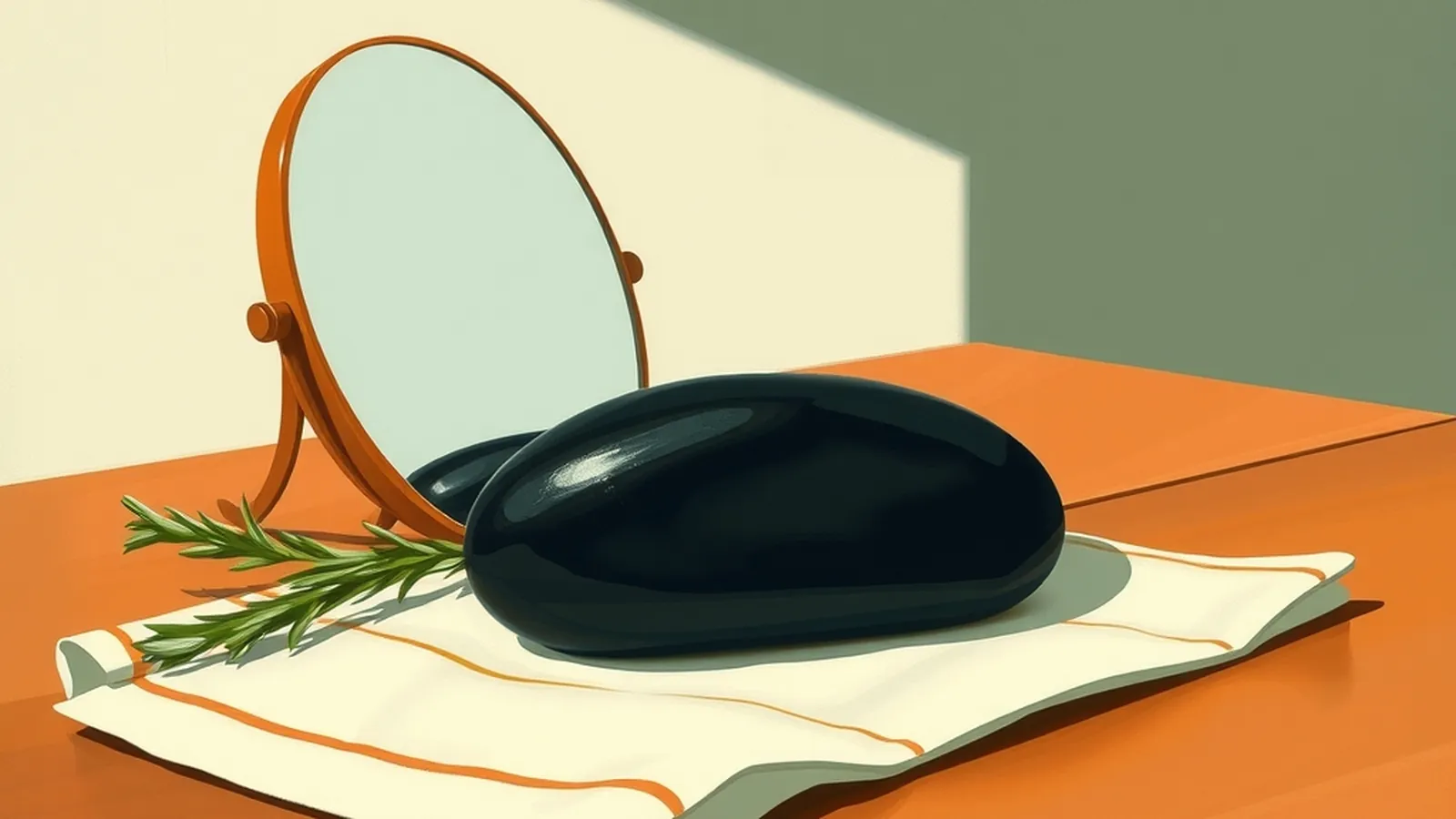
Its most distinctive association is with honesty. Because polished obsidian is so reflective, it has long been linked with mirrors. Polished obsidian mirrors were made in ancient Mesoamerica, and the idea of a dark mirror carries into modern practice as a symbol of facing yourself clearly. Some practitioners describe obsidian as a stone for "shadow" work, meaning the parts of yourself you tend to hide or judge.
It's worth saying plainly: there's no scientific evidence that crystals have healing or energetic effects. When small experiments have compared real crystals with convincing fakes, people tended to report similar sensations either way. That points to expectation and ritual as the source of what people feel, which doesn't make the experience meaningless.
Chakra and zodiac associations
In the modern Western chakra system, obsidian is most often linked with the root chakra, the energy center associated with safety, stability and belonging. Its dark color and grounding reputation make this pairing common. Some lists also connect it with Scorpio or Capricorn. These are modern conventions that vary from one source to another, not ancient rules.
How people use obsidian
People use obsidian in a few practical ways:
- As a reflection tool. Hold a polished piece while journaling about something you've been avoiding.
- As a grounding object. Keep a tumbled stone in a pocket and touch it when you notice yourself spinning out.
- As decor. A polished sphere or slab on a desk can act as a cue to pause.
- In jewelry. Obsidian beads are common, though the stone can chip if knocked against hard surfaces.
The stone is the reminder; the practice is what you do afterward. If you're using obsidian for "protection," pair it with real-world steps like setting a boundary or stepping away from a draining situation.
A short reflection practice
Obsidian's mirror association makes it a natural fit for shadow work, the practice of gently noticing reactions and patterns you'd usually push away. Try this:
- Sit somewhere quiet with a polished piece of obsidian in your hand.
- Take five slow breaths, feeling the cool weight of the stone.
- Look at your reflection in the surface, or simply at the dark glass.
- Ask yourself: "What reaction of mine have I been explaining away lately?"
- Write for five minutes without editing.
- Close by naming one small, kind action you can take in response.
If this kind of reflection brings up painful memories or feels overwhelming, stop and consider talking with a licensed therapist. Shadow work is meant to be gentle, not forced.
Care and safety
Obsidian is easy to care for, with one serious caution: sharp edges.
- Handle raw pieces carefully. Freshly broken or rough obsidian can cut skin as easily as broken glass. Hold it by the smoother sides, and don't run your fingers along edges.
- Check tumbled stones for chips. A dropped stone can develop a new sharp edge. If it does, retire it to a shelf rather than your pocket.
- Keep it away from young children and pets. Small pieces are also a choking hazard.
- Water is generally fine. A quick rinse and a soft cloth work well. Avoid harsh chemicals.
- Avoid knocks and sudden temperature changes. Like any glass, it can chip or crack.
- Never ingest it or make drinking "elixirs." Glass shards are dangerous, and no stone belongs in your drinking water.
For a full rundown of cleansing methods and which stones each is safe for, see how to cleanse crystals.
Buying tips
Obsidian is common and usually affordable, but a few things are worth knowing:
- Man-made glass is sometimes sold as obsidian. Brightly colored "obsidian" in blue, green or other vivid shades is often manufactured glass. Natural obsidian is mostly black, brown or gray, sometimes with a sheen.
- Ask about origin. Obsidian is found in volcanic regions around the world, and a good seller can tell you where theirs came from.
- Raw versus tumbled. If you want something to carry or give to someone else, choose a tumbled or polished piece.
Related stones
If obsidian appeals to you, a few other stones share its themes. Black tourmaline is the other classic dark "protection" stone in crystal tradition, so the two are often paired for grounding work. Labradorite shares obsidian's reputation as a stone for looking inward, though its flashes of color give it a lighter feel. And carnelian offers a warm contrast: where obsidian is about reflection, carnelian is linked with motivation and getting moving.
Journal prompts
- Where in my life am I avoiding an honest look?
- What would "feeling grounded" look like in an ordinary weekday?
- Which boundary have I been meaning to set, and what's one step toward it?
- What did I learn the last time I faced something I'd been avoiding?
Want a structured program to go deeper?
Reading is a start. Some people do better with a guided course they can follow day by day. This button opens a manifestation or meditation program from one of our advertising partners.
See the partner program →We may be paid when you click. The program shown can change. Read its terms before you buy anything. How this works
Frequently asked questions
What does obsidian mean spiritually?
In modern crystal belief, obsidian is linked with grounding, protection and seeing yourself honestly, which is why it's often called a "mirror" stone. These are traditions, not proven effects.
Is obsidian a real crystal?
Not technically. Obsidian is natural volcanic glass that cooled too quickly for crystals to form, so it has no crystal structure, even though it's sold alongside crystals.
Is obsidian dangerous to handle?
Polished, tumbled obsidian is generally safe to handle. Raw or chipped pieces can have edges sharp enough to cut skin, so handle them carefully and keep them away from young children and pets.